My Childhood Under the El – Carol Vento
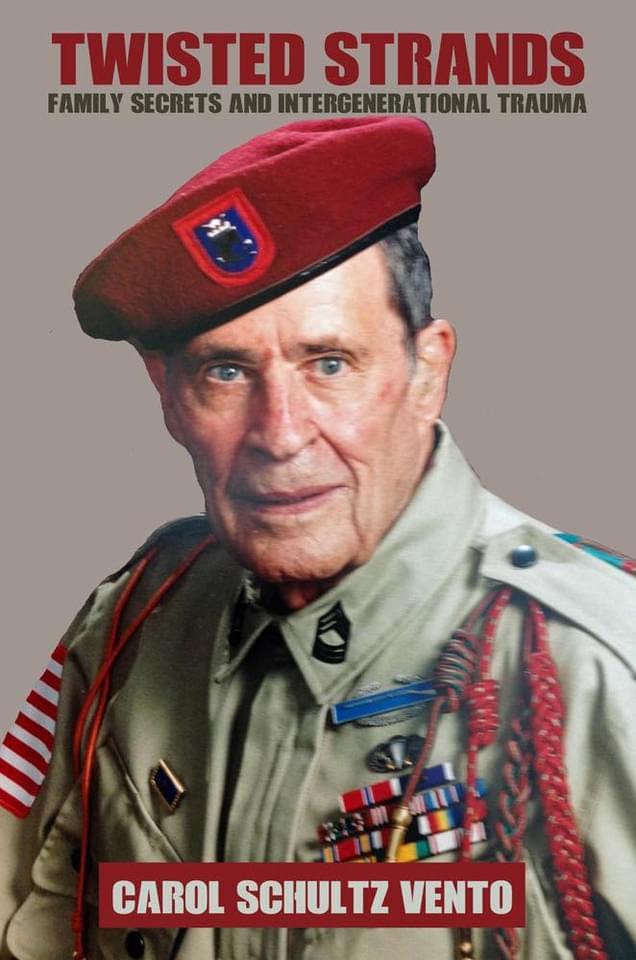
I was born a sickly, scrawny five-pound, full term baby in a Philadelphia working class Catholic hospital in October 1946. Peeling, green hued columns stolidly supporting massive elevated trains shadowed the place of my birth – Saint Mary’s. Staffed by St. Francis nuns, who followed the lead of Philadelphia’s St. John Neumann, had served the medical needs of the city’s poor and working class since the 1800s. My family qualified. An Italian American beautician, daughter of immigrants, and a traumatized WWII paratrooper had married quickly in 1945 after my dad’s return from war. Communicating by letters during the battle years, the boy from Michigan and the sheltered Italian girl had spent a paltry three weeks together before dad shipped out to Europe. After their marriage, my mother was initially the sole source of family income. She rode dusty thatched seated elevated train daily into center city Philly where she twisted curls and Aquanetted updos into hair helmets. My dad’s combat skills of jumping from planes and manning BAR machine guns were not valued in the civilian world.
Ten months after the wedding, I arrived as an unplanned surprise. I was a miniature Dumbo baby, bald with oversized ears. I cried incessantly, disrupting everyone’s sleep. Our Frankford row house, sliced in the middle of an ethnic/racial hardscrabble Philly neighborhood had three box-sized bedrooms, a smoky coal eating furnace and a sparse no sink bathroom. 2 of my mother’s unmarried siblings shared the cramped space with us.
A working class baby girl born at the beginning of the post WWII era was not a significant event. Millions of baby boomers arrived after the war, a reflection of the pent up desires of returning GIs wishing to create life after the horror and destruction. My future seemed predestined. I would either be an office or factory drone or a pink-collar worker like my mother.
I was colicky and a poor sleeper. My shell-shocked trooper dad, with night terrors, was not ready for a squalling baby. His quick descent into fatherhood so soon after the war left him feeling trapped. By Christmas of 1946, he had left the home to try to “find himself”. Much of baby care was done not only by my mother, but also her siblings.
Uncle Tony, the eldest and only boy among four children of my Italian immigrant grandparents, took command. He was short in stature but long on personality, jovial and outgoing. Tony was nine years old when his father, 32 year old Luigi, died in 1924 in a rural Pennsylvania sanitarium for the tubercular. At 18, Luigi had arrived in America from Solafra, Avellino province through chain migration, sponsored by his older brother Vito. Luigi quickly obtained employment at Stetson Hat Factory. Owner John Stetson encouraged migration from Italy by offering immigrants Americanization classes to prepare for naturalization. Italian hatters and clothing workers filled an increasing demand for Stetson hats.
Luigi’s premature and unfortunate death left my grandmother Michelina with 4 children under the age of 10 and no income. 9 year old Tony quickly assumed the role of man of the house and protector of his 3 sisters, my mother was the youngest, only 2 ½ at her father’s death. Michelina had emigrated to America with her parents in 1911 from the province of Salerno, Italy. She was a young immigrant widow by 1924, relying on the assistance of her family and her African American neighbors in her close knit Philly neighborhood.
The Italian precept of “la famiglia” was strong in my extended family – it was a generational mandate. Grandmom had survived and successfully raised her children with the aid of family. The same type of help was given to my mother with her absent husband. Uncle Tony was my godfather and took his role seriously while my father was away, washing me in a bathinette he had specially constructed. My mother’s sister, Annie, a gifted seamstress, fed me, coddled me, often sewing me elaborate girly dresses. Grandmom Michelina lived around the corner, coming to our house every day for breakfast and to walk me in my coach. The tight knit family closed ranks to take care of me during my dad’s hiatus – a pattern that would be repeated many times during my childhood and teen years.
My Midwestern father, who had grown up in Michigan, returned to America from the war in Europe to a household filled with Italians in December 1945. Unable to find satisfactory civilian work, he reenlisted in the Army as a Counterintelligence Corp agent. He soon was gone again for training at Fort Holabird in Maryland, but not before my mother again became unexpectedly pregnant. This pregnancy ended in tragedy. The baby girl, Mary Anne, was born with microcephaly and underdeveloped lungs on November 18, 1947. She died two days later, untreated by doctors who told my father there was no hope of survival for the baby. The baby was never seen nor held by my mother on the advice of her doctor, a loss my mother regretted the rest of her life. Eventually, November turned out to be a cold, callous month in our family’s tapestry with another unimaginable loss occurring decades later.
My memories of preschool years are scant, mainly colored by stories told by my parents. I was a voracious reader, dad recounted that I had either memorized or could actually read my favorite books at age 3. My first vivid memory is being on a beach with extended family, building sand castles by the ocean. Looking up, I saw a sea of unrecognizable faces, and I began to wail loudly. All of a sudden my aunt appeared, swooped me up and rescued me – a role she would play many times in my life. Aunt Annie was my constant 911 call throughout my young years. Gregarious and attractive with glossy black hair and a curvaceous Italian figure, she had waited for her first love who had been absent in the Pacific theater of war for four years. They married and my aunt left the small rowhouse and moved a few miles away to a newly constructed postwar neighborhood named Mayfair that had modern rowhouses, lush green lawns, and spacious garages. Uncle Tony also relocated to the verdant open streets of Mayfair marrying a second generation Italian from South Philly, the urban village clustered with Italian immigrants.
Meanwhile, I was still an only child in Frankford, growing up on the wrong side of the tracks, literally. The Market Frankford elevated train line bisected the neighborhood geographically, racially and class wise. East Frankford was lower middle class, lower income and the home of many African Americans who had settled as free blacks in that area in the early 1800s. By the 1850s half the blacks in Frankford owned their own homes. There was a large enough African American community that they had their own net work of small business owners, Some worked brick laying jobs for James Horrocks, a white business who hired both blacks and whites, an unusual practice at the time.
The influence of the African American community was imprinted on me from an early age. My lullaby during the summertime would often be the sounds of Do-Wop from Bus and Lil’s bar across the street. Black owned after the previous German immigrant owners sold, the dulcet sounds of The Five Satins would drift into the bedroom, the melody filtered through the whir of the fan, in the days before air conditioning.
Italian immigrants also clustered in Frankford, mainly living in the same area where blacks were residing. Recently arriving in Americans, the Italians felt uncomfortable at the Irish Catholic church in the neighborhood and petitioned the archdiocese to establish their own ethnic parish. In 1911, Mater Dolorosa was built. And my relatives were devout members in a church more compatible with their religious and cultural customs.
Old world customs were responsible for getting my affairs in order with a will. I was surrounded by symbols of a non-earthly world. The Virgin Mary statue, beneficent in a powder blue robe, looked down on my bed from her perch on the bureau. Joining her was the every changing Infant of Prague, with ornate outfits to honor the liturgical seasons. The talisman that affected me the most was the burnished brown wood crucifix symbolizing Jesus nailed to the cross by his hands and feet. There was a hidden compartment inside which contained the necessities for Extreme Unction, fueling my fear that the last rites of the Catholic church for a dying person might be imminent for me.
My disease of Rheumatic Fever was a serious diagnosis in mid twentieth century America. As a young child, I had many episodes of fevers spiking to 106 degrees, causing hallucinations of bugs crawling on my skin. Fatigue, loss of weight, excessive nosebleeds were additional assaults on my childhood body.
My maternal family hovered. My Italian grandmother would make the sign of the cross on my forehead with oil to rid me of the malocchio, the Italian evil eye, which she believed was connected to my illness.
Another old world belief was that a half onion placed within a sock on the sole of the foot would lower a fever. The memory of the pungent odor emanating from my feverish foot lingered throughout adulthood, the reason for my lifelong distaste of onions. Paper bags were also a home remedy. A swatch of the brown paper was placed under my top lip to stop the gushing blood.
These religious talismans and cultural practices reinforced by sense of impending doom along with being bedridden and kept from school for a year and a half with a “home school” teacher coming to my beside to keep me up to date with my second and third grade learning.
Being afflicted with “smart kid disease”, I was intellectually aware I was quite sickly, and connected sickness with death – which compelled me to write my will at the age of ten, leaving my clothes to my mother, books to my father, toys to my little sister, and a lock of hair to my best friend. Contrary to my fears, I have lived a long life. Ironically, my healthy vibrant, little sister Rosemary, born four and a half years after me, died at the young age of twenty-two, in a 1973 Thanksgiving accident, joining my baby sister MaryAnn who had also died at two days old on a bleak, dreary November twenty six years earlier.
My Childhood Under the El – Carol Vento
I was born a sickly, scrawny five-pound, full term baby in a Philadelphia working class Catholic hospital in October 1946. Peeling, green hued columns stolidly supporting massive elevated trains shadowed the place of my birth – Saint Mary’s. Staffed by St. Francis nuns, who followed the lead of Philadelphia’s St. John Neumann, had served the medical needs of the city’s poor and working class since the 1800s. My family qualified. An Italian American beautician, daughter of immigrants, and a traumatized WWII paratrooper had married quickly in 1945 after my dad’s return from war. Communicating by letters during the battle years, the boy from Michigan and the sheltered Italian girl had spent a paltry three weeks together before dad shipped out to Europe. After their marriage, my mother was initially the sole source of family income. She rode dusty thatched seated elevated train daily into center city Philly where she twisted curls and Aquanetted updos into hair helmets. My dad’s combat skills of jumping from planes and manning BAR machine guns were not valued in the civilian world.
Ten months after the wedding, I arrived as an unplanned surprise. I was a miniature Dumbo baby, bald with oversized ears. I cried incessantly, disrupting everyone’s sleep. Our Frankford row house, sliced in the middle of an ethnic/racial hardscrabble Philly neighborhood had three box-sized bedrooms, a smoky coal eating furnace and a sparse no sink bathroom. 2 of my mother’s unmarried siblings shared the cramped space with us.
A working class baby girl born at the beginning of the post WWII era was not a significant event. Millions of baby boomers arrived after the war, a reflection of the pent up desires of returning GIs wishing to create life after the horror and destruction. My future seemed predestined. I would either be an office or factory drone or a pink-collar worker like my mother.
I was colicky and a poor sleeper. My shell-shocked trooper dad, with night terrors, was not ready for a squalling baby. His quick descent into fatherhood so soon after the war left him feeling trapped. By Christmas of 1946, he had left the home to try to “find himself”. Much of baby care was done not only by my mother, but also her siblings.
Uncle Tony, the eldest and only boy among four children of my Italian immigrant grandparents, took command. He was short in stature but long on personality, jovial and outgoing. Tony was nine years old when his father, 32 year old Luigi, died in 1924 in a rural Pennsylvania sanitarium for the tubercular. At 18, Luigi had arrived in America from Solafra, Avellino province through chain migration, sponsored by his older brother Vito. Luigi quickly obtained employment at Stetson Hat Factory. Owner John Stetson encouraged migration from Italy by offering immigrants Americanization classes to prepare for naturalization. Italian hatters and clothing workers filled an increasing demand for Stetson hats.
Luigi’s premature and unfortunate death left my grandmother Michelina with 4 children under the age of 10 and no income. 9 year old Tony quickly assumed the role of man of the house and protector of his 3 sisters, my mother was the youngest, only 2 ½ at her father’s death. Michelina had emigrated to America with her parents in 1911 from the province of Salerno, Italy. She was a young immigrant widow by 1924, relying on the assistance of her family and her African American neighbors in her close knit Philly neighborhood.
The Italian precept of “la famiglia” was strong in my extended family – it was a generational mandate. Grandmom had survived and successfully raised her children with the aid of family. The same type of help was given to my mother with her absent husband. Uncle Tony was my godfather and took his role seriously while my father was away, washing me in a bathinette he had specially constructed. My mother’s sister, Annie, a gifted seamstress, fed me, coddled me, often sewing me elaborate girly dresses. Grandmom Michelina lived around the corner, coming to our house every day for breakfast and to walk me in my coach. The tight knit family closed ranks to take care of me during my dad’s hiatus – a pattern that would be repeated many times during my childhood and teen years.
My Midwestern father, who had grown up in Michigan, returned to America from the war in Europe to a household filled with Italians in December 1945. Unable to find satisfactory civilian work, he reenlisted in the Army as a Counterintelligence Corp agent. He soon was gone again for training at Fort Holabird in Maryland, but not before my mother again became unexpectedly pregnant. This pregnancy ended in tragedy. The baby girl, Mary Anne, was born with microcephaly and underdeveloped lungs on November 18, 1947. She died two days later, untreated by doctors who told my father there was no hope of survival for the baby. The baby was never seen nor held by my mother on the advice of her doctor, a loss my mother regretted the rest of her life. Eventually, November turned out to be a cold, callous month in our family’s tapestry with another unimaginable loss occurring decades later.
My memories of preschool years are scant, mainly colored by stories told by my parents. I was a voracious reader, dad recounted that I had either memorized or could actually read my favorite books at age 3. My first vivid memory is being on a beach with extended family, building sand castles by the ocean. Looking up, I saw a sea of unrecognizable faces, and I began to wail loudly. All of a sudden my aunt appeared, swooped me up and rescued me – a role she would play many times in my life. Aunt Annie was my constant 911 call throughout my young years. Gregarious and attractive with glossy black hair and a curvaceous Italian figure, she had waited for her first love who had been absent in the Pacific theater of war for four years. They married and my aunt left the small rowhouse and moved a few miles away to a newly constructed postwar neighborhood named Mayfair that had modern rowhouses, lush green lawns, and spacious garages. Uncle Tony also relocated to the verdant open streets of Mayfair marrying a second generation Italian from South Philly, the urban village clustered with Italian immigrants.
Meanwhile, I was still an only child in Frankford, growing up on the wrong side of the tracks, literally. The Market Frankford elevated train line bisected the neighborhood geographically, racially and class wise. East Frankford was lower middle class, lower income and the home of many African Americans who had settled as free blacks in that area in the early 1800s. By the 1850s half the blacks in Frankford owned their own homes. There was a large enough African American community that they had their own net work of small business owners, Some worked brick laying jobs for James Horrocks, a white business who hired both blacks and whites, an unusual practice at the time.
The influence of the African American community was imprinted on me from an early age. My lullaby during the summertime would often be the sounds of Do-Wop from Bus and Lil’s bar across the street. Black owned after the previous German immigrant owners sold, the dulcet sounds of The Five Satins would drift into the bedroom, the melody filtered through the whir of the fan, in the days before air conditioning.
Italian immigrants also clustered in Frankford, mainly living in the same area where blacks were residing. Recently arriving in Americans, the Italians felt uncomfortable at the Irish Catholic church in the neighborhood and petitioned the archdiocese to establish their own ethnic parish. In 1911, Mater Dolorosa was built. And my relatives were devout members in a church more compatible with their religious and cultural customs.
Old world customs were responsible for getting my affairs in order with a will. I was surrounded by symbols of a non-earthly world. The Virgin Mary statue, beneficent in a powder blue robe, looked down on my bed from her perch on the bureau. Joining her was the every changing Infant of Prague, with ornate outfits to honor the liturgical seasons. The talisman that affected me the most was the burnished brown wood crucifix symbolizing Jesus nailed to the cross by his hands and feet. There was a hidden compartment inside which contained the necessities for Extreme Unction, fueling my fear that the last rites of the Catholic church for a dying person might be imminent for me.
My disease of Rheumatic Fever was a serious diagnosis in mid twentieth century America. As a young child, I had many episodes of fevers spiking to 106 degrees, causing hallucinations of bugs crawling on my skin. Fatigue, loss of weight, excessive nosebleeds were additional assaults on my childhood body.
My maternal family hovered. My Italian grandmother would make the sign of the cross on my forehead with oil to rid me of the malocchio, the Italian evil eye, which she believed was connected to my illness.
Another old world belief was that a half onion placed within a sock on the sole of the foot would lower a fever. The memory of the pungent odor emanating from my feverish foot lingered throughout adulthood, the reason for my lifelong distaste of onions. Paper bags were also a home remedy. A swatch of the brown paper was placed under my top lip to stop the gushing blood.
These religious talismans and cultural practices reinforced by sense of impending doom along with being bedridden and kept from school for a year and a half with a “home school” teacher coming to my beside to keep me up to date with my second and third grade learning.
Being afflicted with “smart kid disease”, I was intellectually aware I was quite sickly, and connected sickness with death – which compelled me to write my will at the age of ten, leaving my clothes to my mother, books to my father, toys to my little sister, and a lock of hair to my best friend. Contrary to my fears, I have lived a long life. Ironically, my healthy vibrant, little sister Rosemary, born four and a half years after me, died at the young age of twenty-two, in a 1973 Thanksgiving accident, joining my baby sister MaryAnn who had also died at two days old on a bleak, dreary November twenty six years earlier.
My Childhood Under the El – Carol Vento
I was born a sickly, scrawny five-pound, full term baby in a Philadelphia working class Catholic hospital in October 1946. Peeling, green hued columns stolidly supporting massive elevated trains shadowed the place of my birth – Saint Mary’s. Staffed by St. Francis nuns, who followed the lead of Philadelphia’s St. John Neumann, had served the medical needs of the city’s poor and working class since the 1800s. My family qualified. An Italian American beautician, daughter of immigrants, and a traumatized WWII paratrooper had married quickly in 1945 after my dad’s return from war. Communicating by letters during the battle years, the boy from Michigan and the sheltered Italian girl had spent a paltry three weeks together before dad shipped out to Europe. After their marriage, my mother was initially the sole source of family income. She rode dusty thatched seated elevated train daily into center city Philly where she twisted curls and Aquanetted updos into hair helmets. My dad’s combat skills of jumping from planes and manning BAR machine guns were not valued in the civilian world.
Ten months after the wedding, I arrived as an unplanned surprise. I was a miniature Dumbo baby, bald with oversized ears. I cried incessantly, disrupting everyone’s sleep. Our Frankford row house, sliced in the middle of an ethnic/racial hardscrabble Philly neighborhood had three box-sized bedrooms, a smoky coal eating furnace and a sparse no sink bathroom. 2 of my mother’s unmarried siblings shared the cramped space with us.
A working class baby girl born at the beginning of the post WWII era was not a significant event. Millions of baby boomers arrived after the war, a reflection of the pent up desires of returning GIs wishing to create life after the horror and destruction. My future seemed predestined. I would either be an office or factory drone or a pink-collar worker like my mother.
I was colicky and a poor sleeper. My shell-shocked trooper dad, with night terrors, was not ready for a squalling baby. His quick descent into fatherhood so soon after the war left him feeling trapped. By Christmas of 1946, he had left the home to try to “find himself”. Much of baby care was done not only by my mother, but also her siblings.
Uncle Tony, the eldest and only boy among four children of my Italian immigrant grandparents, took command. He was short in stature but long on personality, jovial and outgoing. Tony was nine years old when his father, 32 year old Luigi, died in 1924 in a rural Pennsylvania sanitarium for the tubercular. At 18, Luigi had arrived in America from Solafra, Avellino province through chain migration, sponsored by his older brother Vito. Luigi quickly obtained employment at Stetson Hat Factory. Owner John Stetson encouraged migration from Italy by offering immigrants Americanization classes to prepare for naturalization. Italian hatters and clothing workers filled an increasing demand for Stetson hats.
Luigi’s premature and unfortunate death left my grandmother Michelina with 4 children under the age of 10 and no income. 9 year old Tony quickly assumed the role of man of the house and protector of his 3 sisters, my mother was the youngest, only 2 ½ at her father’s death. Michelina had emigrated to America with her parents in 1911 from the province of Salerno, Italy. She was a young immigrant widow by 1924, relying on the assistance of her family and her African American neighbors in her close knit Philly neighborhood.
The Italian precept of “la famiglia” was strong in my extended family – it was a generational mandate. Grandmom had survived and successfully raised her children with the aid of family. The same type of help was given to my mother with her absent husband. Uncle Tony was my godfather and took his role seriously while my father was away, washing me in a bathinette he had specially constructed. My mother’s sister, Annie, a gifted seamstress, fed me, coddled me, often sewing me elaborate girly dresses. Grandmom Michelina lived around the corner, coming to our house every day for breakfast and to walk me in my coach. The tight knit family closed ranks to take care of me during my dad’s hiatus – a pattern that would be repeated many times during my childhood and teen years.
My Midwestern father, who had grown up in Michigan, returned to America from the war in Europe to a household filled with Italians in December 1945. Unable to find satisfactory civilian work, he reenlisted in the Army as a Counterintelligence Corp agent. He soon was gone again for training at Fort Holabird in Maryland, but not before my mother again became unexpectedly pregnant. This pregnancy ended in tragedy. The baby girl, Mary Anne, was born with microcephaly and underdeveloped lungs on November 18, 1947. She died two days later, untreated by doctors who told my father there was no hope of survival for the baby. The baby was never seen nor held by my mother on the advice of her doctor, a loss my mother regretted the rest of her life. Eventually, November turned out to be a cold, callous month in our family’s tapestry with another unimaginable loss occurring decades later.
My memories of preschool years are scant, mainly colored by stories told by my parents. I was a voracious reader, dad recounted that I had either memorized or could actually read my favorite books at age 3. My first vivid memory is being on a beach with extended family, building sand castles by the ocean. Looking up, I saw a sea of unrecognizable faces, and I began to wail loudly. All of a sudden my aunt appeared, swooped me up and rescued me – a role she would play many times in my life. Aunt Annie was my constant 911 call throughout my young years. Gregarious and attractive with glossy black hair and a curvaceous Italian figure, she had waited for her first love who had been absent in the Pacific theater of war for four years. They married and my aunt left the small rowhouse and moved a few miles away to a newly constructed postwar neighborhood named Mayfair that had modern rowhouses, lush green lawns, and spacious garages. Uncle Tony also relocated to the verdant open streets of Mayfair marrying a second generation Italian from South Philly, the urban village clustered with Italian immigrants.
Meanwhile, I was still an only child in Frankford, growing up on the wrong side of the tracks, literally. The Market Frankford elevated train line bisected the neighborhood geographically, racially and class wise. East Frankford was lower middle class, lower income and the home of many African Americans who had settled as free blacks in that area in the early 1800s. By the 1850s half the blacks in Frankford owned their own homes. There was a large enough African American community that they had their own net work of small business owners, Some worked brick laying jobs for James Horrocks, a white business who hired both blacks and whites, an unusual practice at the time.
The influence of the African American community was imprinted on me from an early age. My lullaby during the summertime would often be the sounds of Do-Wop from Bus and Lil’s bar across the street. Black owned after the previous German immigrant owners sold, the dulcet sounds of The Five Satins would drift into the bedroom, the melody filtered through the whir of the fan, in the days before air conditioning.
Italian immigrants also clustered in Frankford, mainly living in the same area where blacks were residing. Recently arriving in Americans, the Italians felt uncomfortable at the Irish Catholic church in the neighborhood and petitioned the archdiocese to establish their own ethnic parish. In 1911, Mater Dolorosa was built. And my relatives were devout members in a church more compatible with their religious and cultural customs.
Old world customs were responsible for getting my affairs in order with a will. I was surrounded by symbols of a non-earthly world. The Virgin Mary statue, beneficent in a powder blue robe, looked down on my bed from her perch on the bureau. Joining her was the every changing Infant of Prague, with ornate outfits to honor the liturgical seasons. The talisman that affected me the most was the burnished brown wood crucifix symbolizing Jesus nailed to the cross by his hands and feet. There was a hidden compartment inside which contained the necessities for Extreme Unction, fueling my fear that the last rites of the Catholic church for a dying person might be imminent for me.
My disease of Rheumatic Fever was a serious diagnosis in mid twentieth century America. As a young child, I had many episodes of fevers spiking to 106 degrees, causing hallucinations of bugs crawling on my skin. Fatigue, loss of weight, excessive nosebleeds were additional assaults on my childhood body.
My maternal family hovered. My Italian grandmother would make the sign of the cross on my forehead with oil to rid me of the malocchio, the Italian evil eye, which she believed was connected to my illness.
Another old world belief was that a half onion placed within a sock on the sole of the foot would lower a fever. The memory of the pungent odor emanating from my feverish foot lingered throughout adulthood, the reason for my lifelong distaste of onions. Paper bags were also a home remedy. A swatch of the brown paper was placed under my top lip to stop the gushing blood.
These religious talismans and cultural practices reinforced by sense of impending doom along with being bedridden and kept from school for a year and a half with a “home school” teacher coming to my beside to keep me up to date with my second and third grade learning.
Being afflicted with “smart kid disease”, I was intellectually aware I was quite sickly, and connected sickness with death – which compelled me to write my will at the age of ten, leaving my clothes to my mother, books to my father, toys to my little sister, and a lock of hair to my best friend. Contrary to my fears, I have lived a long life. Ironically, my healthy vibrant, little sister Rosemary, born four and a half years after me, died at the young age of twenty-two, in a 1973 Thanksgiving accident, joining my baby sister MaryAnn who had also died at two days old on a bleak, dreary November twenty six years earlier.